For a first tool that must make holes and drive occasional screws, a drill/driver is usually the more flexible starting point. An impact driver becomes useful when repeated screwdriving is the main job. Owning both lets you keep a drill bit in one and a driving bit in the other, but a two-tool kit is not automatically better value for occasional work.
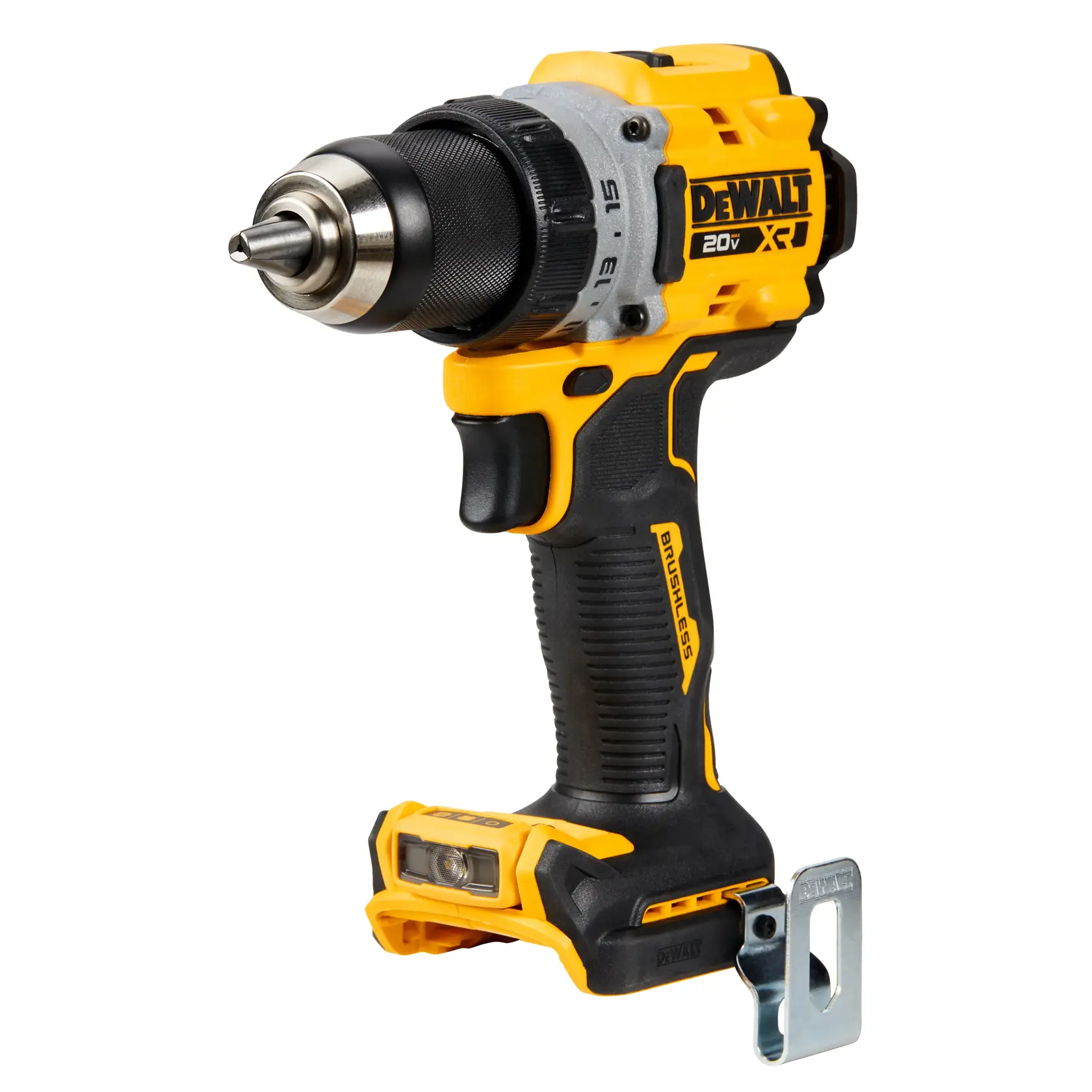
How this guide was prepared: This is a source-based buying comparison, not a hands-on test. The photograph shows a real DeWalt DCD800 drill/driver, sourced from the manufacturer; it does not show an impact driver or everything included in a kit. Manufacturer links below are reference links, not a claim of an approved affiliate relationship.
Choose from the job you actually have
| Your main task | First tool to consider | Why it matters |
|---|---|---|
| Pilot holes and general drilling within the tool’s capacity | Drill/driver | A three-jaw chuck accepts suitable drilling accessories |
| Occasional screws in small projects | Drill/driver or hand screwdriver | An adjustable clutch can help with fastening control |
| Repeated construction screwdriving | Impact driver | Designed around a quick-release hex holder and rotational impacts |
| Delicate furniture fittings | Hand screwdriver or suitable low-clutch setting | High fastening power can damage small fittings |
| Holes in masonry | A suitable hammer drill or rotary hammer | An impact driver is not a substitute for axial hammering |
The workpiece, fastener and accessory instructions still matter. An impact driver does not remove a fastener manufacturer’s requirement for a pilot hole.
Check the chuck, not the shape of the housing
A drill/driver generally has a three-jaw chuck tightened around the accessory. An impact driver commonly has a quarter-inch hex quick-release holder. Similar yellow-and-black housings can hide tools with different purposes.
For a concrete example, DeWalt identifies the DCD800B as a half-inch drill/driver sold tool-only. Its product photograph is used here. The DCF850 manual identifies a quarter-inch hex quick-release chuck. These examples illustrate the two formats; they are not a measured performance ranking.
A hex-shaped accessory is not automatically suitable for impact use. Check that the bit or holder is approved for the tool and application. Do not infer compatibility from whether it physically fits.
A clutch and an impact mechanism do different jobs
A drill’s adjustable clutch limits fastening torque at a selected setting. Drilling mode is different: the DCD800/DCD805 manual explains the controls and mode differences. Read the instructions for your exact model; features shown for the DCD805 in a shared manual do not automatically apply to the DCD800.
An impact driver’s mechanism applies rotational impacts under load. That is different from the axial hammering used by a hammer drill. An impact wrench is also a separate tool category; a quarter-inch impact driver should not be treated as an automotive wheel-fastening solution.
Neither tool is immune to binding or loss of control. The previous version overstated protection from kickback; that claim has been removed.
Compare the complete cost before buying
Use the exact model suffix and contents list, not just the hero photograph. “Tool-only” and “kit” listings can look similar while including different equipment.
- Check whether a compatible battery and charger are included.
- Check the battery platform against the manufacturer’s compatibility information.
- Add the cost of suitable drill bits, driving bits and any required holders.
- Check whether the advertised case and accessories are actually included.
- Compare the delivered total and return terms for the exact package.
If you already own compatible batteries, a tool-only purchase may make sense. If you do not, compare the total cost of a usable setup. Do not buy a second tool just to make a discounted bundle feel worthwhile.
Before the first job
Read the tool and accessory instructions, secure the workpiece, use the specified protective equipment and maintain a firm grip. Disconnect the battery before changing accessories as directed in the manual. Stay within the stated capacities; this comparison is not an operating procedure for drilling hidden services or structural work.
Choose the drill/driver first when you need a mix of holes and light fastening. Add an impact driver when the work you actually do justifies a dedicated fastening tool. For another task-based comparison, see jigsaw versus circular saw.