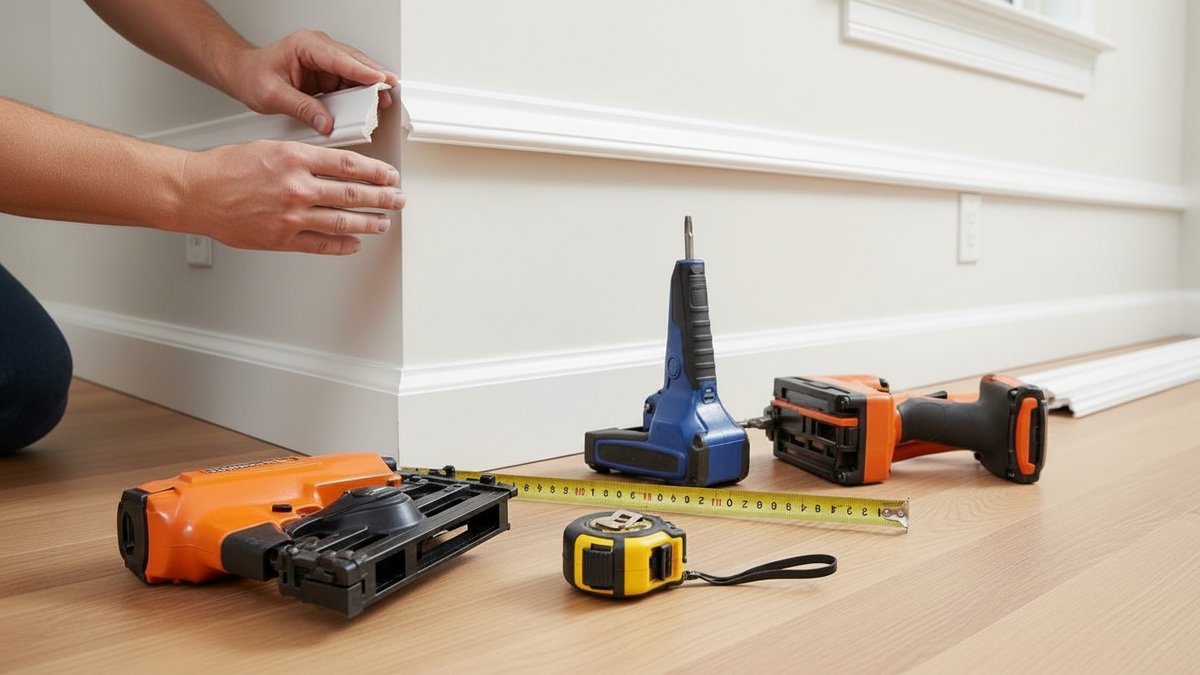
Why Crown Molding Transforms a Room
Crown molding is the trim that bridges the gap between your walls and ceiling. It covers an ugly joint, adds architectural detail, and makes a room feel finished and intentional. A room without crown molding can look fine. A room with well-installed crown molding looks significantly better. The difference is noticeable from the moment you walk in.
The reason most DIYers avoid crown molding is the cutting. Crown sits at an angle between two planes (wall and ceiling), which means every cut is a compound angle. Inside corners, outside corners, miters, copes — the geometry gets tricky fast. But once you understand the spring angle and learn the cope cut technique, it’s a manageable weekend project. This guide breaks it all down.
Tools and Materials
Tools
- Miter saw (10” or 12” — compound or sliding preferred)
- Coping saw (for inside corners)
- Brad nailer (18-gauge) or finish nailer (15/16-gauge)
- Air compressor (if using pneumatic nailer) or cordless nailer
- Stud finder
- Tape measure
- Pencil
- Level
- Ladder or scaffolding
- Sandpaper (150-grit)
- Caulk gun
If you need a miter saw, check our miter saw buying guide for picks at every budget.
Materials
- Crown molding (measure room perimeter + 10% for waste)
- 2” brad nails or finish nails
- Paintable caulk
- Wood filler
- Paint or primer (if using paintable molding)
Choosing Your Crown Molding Material
Solid wood (pine, poplar, oak). Traditional choice. Easy to cut and cope, takes paint and stain beautifully. Heavier, more expensive ($1.50-5/linear ft for pine, much more for hardwoods). Best for paint-grade or stain-grade finished rooms.
MDF (medium-density fiberboard). Lightweight, pre-primed, and extremely smooth. Won’t warp or have knots. Cheaper than solid wood ($0.80-2/linear ft). Cannot be stained — paint only. Slightly more brittle when coping, but very workable.
Polyurethane. Lightweight foam molding that looks like painted wood from floor level. Installs with adhesive and a few pins. Very easy to cut with a miter saw. Won’t rot in humid rooms. $1-4/linear ft. Cannot be stained.
Polystyrene (foam). The lightest and cheapest option ($0.50-1/linear ft). Cuts with a utility knife. Glues to the wall. Fine for budget projects, but the detail and durability are noticeably lower than the other options.
For most rooms, MDF or polyurethane gives you the best combination of looks, workability, and price.
Understanding the Spring Angle
Crown molding doesn’t sit flat against the wall or ceiling. It “springs” off the wall at an angle, typically 38 degrees or 45 degrees. This is called the spring angle, and it determines how you position the molding in your miter saw for cuts.
38-degree spring angle (also called 38/52). The most common residential crown. The back of the molding contacts the wall at 38 degrees from the wall and 52 degrees from the ceiling.
45-degree spring angle (also called 45/45). Less common, typically on larger or more ornate profiles. Equal angles to wall and ceiling.
Check the label on your molding or hold a piece in position and measure the angle. Getting this wrong means every cut will be off.
Step 1: Measure and Plan
Measure each wall in the room. Add 10 percent for waste and practice cuts. Sketch the room layout and note which corners are inside corners (walls going inward) and which are outside corners (walls going outward). Plan your installation order: start with the wall opposite the door (most visible), then work around the room.
Step 2: Find and Mark Studs
Use a stud finder to locate studs along each wall near the ceiling. Mark them with a light pencil line. You’ll nail the bottom edge of the crown into studs and the top edge into ceiling joists (if accessible) or into a backer block.
Step 3: Cut Inside Corners with a Cope Joint
This is the technique that separates clean crown installation from amateur work. Do not miter inside corners — they’ll open up as the house settles. Instead, use a cope joint.
How to cope:
- Cut the first piece square (90 degrees) and push it tight into the corner. Nail it in place.
- On the second piece, cut a 45-degree inside miter as if you were going to miter the joint.
- The miter cut reveals the profile of the molding on the cut face. Use a coping saw to cut along this profile line, angling the saw back at about 30 degrees to create a back-cut.
- Test-fit the coped piece against the first piece. It should nest perfectly over the profile. Sand any high spots with 150-grit paper.
- Nail the coped piece in place.
The cope cut takes practice. Cut two or three practice pieces from scrap before doing your real corners. Once you get the feel for it, a coped inside corner is tighter and more durable than any miter.
Step 4: Cut Outside Corners with a Miter Joint
Outside corners get a standard miter joint. Set your miter saw to 45 degrees (for a 90-degree corner). Position the crown upside down in the saw — the ceiling edge rests on the saw table, the wall edge rests against the saw fence. This is called “nesting” the crown.
Cut the left piece with a left 45-degree miter. Cut the right piece with a right 45-degree miter. Dry-fit. If the corner isn’t exactly 90 degrees (most aren’t), adjust your angle by half a degree until the joint closes.
Step 5: Nail the Molding in Place
Hold each piece in position and nail through the bottom edge into wall studs using 2-inch brad nails or finish nails. Space nails every 16 inches (at each stud). If you can reach ceiling joists, nail the top edge as well. For ceilings without accessible joists, apply a bead of construction adhesive along the top edge.
Work around the room in order. Each new piece butts into or copes over the previous one.
Step 6: Fill and Caulk
- Fill nail holes with wood filler. Let it dry and sand smooth.
- Run a thin bead of paintable caulk along the top edge (ceiling joint) and bottom edge (wall joint). Smooth with a wet finger.
- Caulk any gaps in cope joints or miter joints.
- Prime and paint if using raw wood or MDF.
Pro Tips
- Always make practice cuts. Crown angles are confusing. Cut scrap pieces until your joints are tight before committing to real stock.
- Label your cuts. Mark each piece with its wall location and which end gets which cut. It’s easy to mix up left and right miters.
- Buy extra material. Crown is cheap. Mistakes are frustrating. Get 15-20 percent more than you need.
- Use a pneumatic or cordless nailer. Hand-nailing crown while balancing on a ladder is miserable and leads to bad joints. A brad nailer is a worthwhile investment or rental.
- Work with a helper. Long pieces of crown need two people to hold in position while nailing.
For information on choosing between brad nailers and finish nailers, see our brad nailer vs finish nailer comparison.
Final Thoughts
Crown molding is one of the highest-impact, lowest-cost upgrades you can make to any room. A $100-200 investment in materials plus a day of work adds visible quality that buyers and guests notice immediately. The cope cut is the skill that makes it all work — once you master it, you can trim an entire house with confidence.
If you’re painting the whole room while the ladders are out, our best paint sprayers for home use roundup covers HVLP and airless units that cut a full room’s paint time by more than half. For more finish carpentry projects, browse the home-improvement category.