Bathroom Renovation Cost Breakdown: Budget, Mid-Range, and High-End
A detailed cost breakdown for bathroom renovations at three budget tiers. Learn exactly where your money goes — fixtures, labor, materials, and timeline — so you can plan your renovation with confidence.
 Build Coded Editorial
 What Does a Bathroom Renovation Actually Cost?
Ask ten contractors what a bathroom renovation costs and you will get ten different answers. That is because “bathroom renovation” covers everything from replacing a faucet and painting the walls to gutting the room down to studs and rebuilding from scratch.
This guide breaks down bathroom renovation costs into three realistic tiers — budget, mid-range, and high-end — with specific dollar amounts for every major component. Whether you are refreshing a guest bath on a tight budget or building your dream primary bathroom, you will know exactly where your money goes before you commit.
All costs are based on a standard 5x8-foot bathroom (40 square feet), which is the most common full bathroom size in American homes. Adjust proportionally for larger spaces.
The Three Budget Tiers at a Glance
| Component | Budget ($3,000-6,000) | Mid-Range ($8,000-15,000) | High-End ($15,000-25,000+) |
|---|---|---|---|
| Scope | Cosmetic refresh | Full update, same layout | Layout change + premium finishes |
| Layout changes | None | Minimal | Yes |
| DIY potential | High | Moderate | Low |
| Timeline | 1-2 weekends | 2-4 weeks | 4-8 weeks |
| Permit needed | Usually no | Maybe | Usually yes |
Budget Tier: $3,000-6,000
A budget renovation keeps the existing layout, plumbing locations, and most of the infrastructure. You are refreshing the look, not rebuilding the room. This tier has the highest DIY potential — most of these tasks can be done yourself with moderate skills.
Cost Breakdown
Vanity and Sink: $200-600 At this tier, you are looking at a pre-assembled vanity from a home improvement store. A 36-inch vanity with sink in the $300-500 range looks dramatically better than the builder-grade unit in most homes. Stay away from anything under $200 — the particle board construction falls apart with bathroom humidity.
Toilet: $150-350 A reliable, well-reviewed toilet like the Toto Drake or American Standard Cadet costs $200-300 and will last 20+ years. This is not where to cut corners — a cheap toilet that clogs constantly is not a savings.
Faucet: $60-150 Budget does not mean ugly. Brands like Moen, Delta, and Glacier Bay offer clean, modern faucets in the $80-120 range. Stick with known brands — they honor warranties and replacement parts are available.
Paint: $30-80 A gallon of quality bathroom paint (mildew-resistant, satin or semi-gloss) costs $35-50. For a 5x8 bathroom, one gallon is usually sufficient. Painting is the single highest-impact budget upgrade.
Mirror: $50-200 Replacing a dated mirror makes a bigger visual impact than almost any other budget change. A framed vanity mirror in the $80-150 range elevates the entire room.
Lighting: $50-200 A new vanity light fixture changes the feel of the bathroom instantly. LED fixtures in the $60-150 range provide better light and use less energy.
Hardware and Accessories: $50-150 New towel bars, toilet paper holder, robe hooks, and cabinet pulls. Small details that make the whole room feel cohesive.
Flooring (Peel-and-Stick): $50-150 Peel-and-stick vinyl tile over existing flooring is the budget approach. Not as durable as LVP, but looks decent and costs very little.
Caulking and Grout Refresh: $20-50 Re-caulking the tub and refreshing discolored grout can make a tired bathroom look clean again.
Total Materials: $660-1,930 Labor (if hiring): $1,500-3,000 DIY Total: $700-2,000
Budget Tier — What You Can DIY
Nearly everything at this tier is DIY-friendly:
- Painting walls and ceiling
- Replacing vanity, faucet, and toilet
- Installing new mirror and light fixtures
- Re-caulking tub and shower
- Installing peel-and-stick flooring
- Swapping hardware and accessories
Budget Tier — Timeline
DIY: 1-2 weekends (spread across 2-3 weeks if working evenings) Professional: 3-5 days
Mid-Range Tier: $8,000-15,000
The mid-range renovation upgrades nearly everything in the bathroom while keeping the same basic layout. Plumbing fixtures stay in their current locations, which avoids the cost of moving drain and supply lines. This tier mixes professional work (tile, plumbing connections) with DIY-able tasks (painting, hardware, accessories).
Cost Breakdown
Vanity and Sink: $500-1,500 At this level, you are looking at solid wood construction, soft-close drawers, and a stone or cultured marble top. A 48-inch double vanity opens up from $800-1,200. Consider a floating vanity for a modern look that also makes the floor easier to clean.
Toilet: $250-500 A comfort-height, elongated bowl toilet with a soft-close seat. The Toto Ultramax II at around $350 is a popular mid-range choice — one-piece design, powerful flush, and a clean aesthetic.
Faucet: $150-400 Mid-range faucets from Delta, Moen, or Kohler offer better finishes (brushed gold, matte black), ceramic disc valves, and metal construction throughout. Expect to pay $200-350 for a quality widespread or single-hole faucet.
Tub/Shower: $1,000-3,500 This is where the mid-range tier diverges significantly from budget. Options include:
- New tub surround: Acrylic or tile surround panels ($800-2,000 installed)
- Shower tile: Ceramic or porcelain tile ($1,500-3,500 installed for a standard 3-wall shower)
- Glass shower door: A frameless glass door ($500-1,200) dramatically upgrades any shower
Tile Flooring: $500-1,500 Porcelain or ceramic floor tile, professionally installed. For a 40-square-foot bathroom, expect $300-600 in materials and $400-800 in labor. Porcelain floor tile in the $3-6/sq ft range offers excellent variety and durability.
Lighting: $200-500 A dedicated vanity light plus a ceiling fixture or recessed lights. Adding a ventilation fan with a built-in light is smart at this tier — expect $150-300 for the fan plus $200-400 for installation if running new ductwork.
Paint: $50-100 Same approach as budget, possibly with more prep work for older walls.
Countertop: Included with vanity or $300-800 If buying a vanity without a top, a quartz or granite countertop for a 48-inch vanity runs $300-800 installed.
Mirror and Medicine Cabinet: $150-500 A recessed medicine cabinet provides storage without taking up wall space. Good options run $200-400.
Hardware and Accessories: $100-300 Matching sets from a single brand create a cohesive look. Moen, Delta, and Kohler all offer coordinated collections.
Total Materials: $3,200-8,600 Labor: $4,000-8,000 Permit (if required): $100-300
Mid-Range Tier — What You Can DIY
- Demolition (carefully — leave plumbing and electrical to pros)
- Painting
- Installing vanity and faucet
- Installing toilet
- Installing mirror, light fixtures, and accessories
- Installing baseboard and trim
Mid-Range Tier — Hire a Pro For
- Tile work (floor and shower walls)
- Plumbing connections for new tub/shower valve
- Electrical work (new circuits, fan installation)
- Glass shower door installation
Mid-Range Tier — Timeline
With professionals: 2-4 weeks Partial DIY: 3-5 weeks (doing finish work yourself while pros handle tile and plumbing)
High-End Tier: $15,000-25,000+
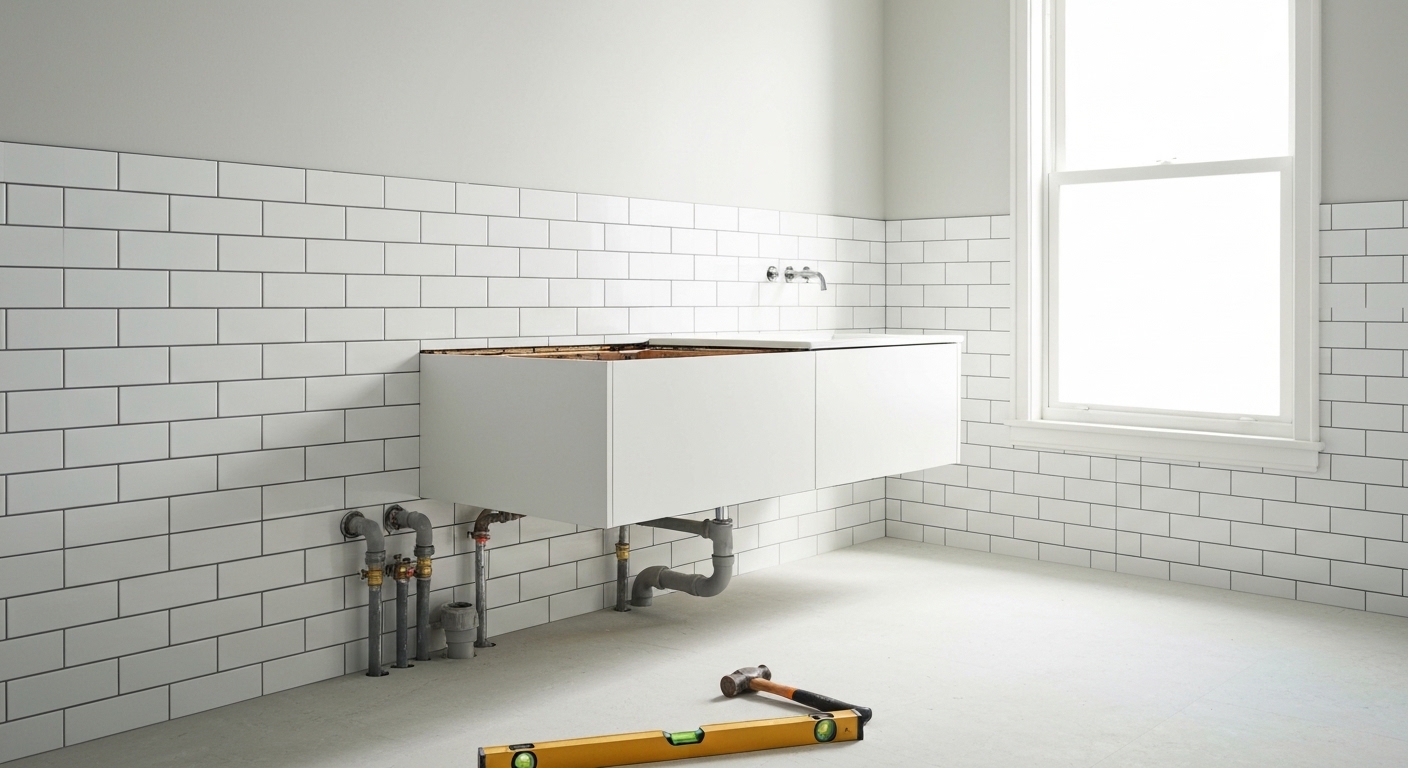
The high-end tier involves layout changes, premium materials, custom features, and professional work throughout. This is a full gut renovation — the room is taken down to studs and rebuilt. Layout changes mean moving plumbing, which is the single most expensive variable in a bathroom renovation.
Cost Breakdown
Custom or Semi-Custom Vanity: $1,500-5,000 Custom cabinetry built to your specifications, or a premium semi-custom unit from brands like RTA or Kraftmaid. Double vanities in the 60-72 inch range with dovetail drawers, full-extension soft-close slides, and premium wood species.
Countertop: $500-2,000 Natural stone (marble, quartzite) or premium quartz. For a double vanity, material plus fabrication and installation runs $800-2,000.
Toilet: $400-1,200 High-end options include wall-mounted toilets ($600-1,000 plus carrier system installation), bidet seats or bidet toilets ($300-800), and one-piece designs from Toto and Kohler.
Faucets: $300-800 Designer faucets from Brizo, Waterstone, or Kohler’s premium lines. Wall-mounted faucets add a luxury aesthetic but require in-wall plumbing.
Shower/Tub: $3,000-8,000 This is the centerpiece of a high-end bathroom:
- Walk-in shower with frameless glass: Large-format porcelain or natural stone tile, linear drain, rain showerhead, handheld wand, and body sprays. Materials and labor: $4,000-8,000.
- Freestanding tub: A freestanding soaking tub ($800-3,000) plus freestanding tub filler ($400-1,500) creates a spa-like focal point.
- Steam shower: Adding a steam generator ($1,000-2,500 installed) turns a shower into a personal steam room.
Tile: $2,000-6,000 Large-format porcelain, natural stone, or designer ceramic on floors and walls. Heated tile floors add $500-1,000 and are worth every penny in a bathroom. Full-room tiling (floor, shower walls, accent wall) with premium materials easily reaches $3,000-6,000 installed.
Lighting: $500-1,500 Layered lighting design with recessed ceiling lights, vanity sconces, shower niche lighting, and possibly a decorative pendant or chandelier. Dimmer switches throughout.
Electrical: $500-1,500 Moving or adding circuits, installing a dedicated GFCI-protected circuit for heated floors, adding outlets for modern conveniences (heated towel bar, bidet seat, smart mirror).
Plumbing: $1,000-4,000 Moving drain locations and supply lines is expensive because it often involves opening floors and walls. A plumber’s rough-in for a relocated shower or tub typically costs $1,500-3,000.
Ventilation: $300-800 A properly sized, quiet exhaust fan (look for sone ratings under 1.0) vented to the exterior. Panasonic WhisperCeiling fans are the gold standard.
Mirror/Medicine Cabinet: $300-1,000 LED-backlit mirrors, heated anti-fog mirrors, or custom framed mirrors.
Hardware and Accessories: $200-600 Premium towel warmers, built-in niches, designer robe hooks, and coordinated accessories.
Demolition and Disposal: $500-1,500 Gutting a bathroom to studs generates significant debris. Dumpster rental runs $300-500, and labor for demolition and haul-away adds $200-1,000.
Permits and Inspections: $200-500 Layout changes involving plumbing and electrical almost always require permits.
Total Materials: $8,000-18,000 Total Labor: $7,000-15,000
High-End Tier — What You Can DIY
At this tier, the DIY opportunities are limited but still real:
- Demolition (with caution around plumbing and electrical)
- Painting
- Installing hardware and accessories
- Some trim work
High-End Tier — Timeline
Full professional renovation: 4-8 weeks, depending on material lead times and inspection schedules
Hidden Costs to Budget For
Every bathroom renovation has costs that catch people off guard. Build these into your budget from the start:
The 15% Contingency Rule
Add 15% to your total budget for unexpected issues. When walls come open, you often find:
- Water damage and mold — Previous leaks may have damaged framing or subfloor. Mold remediation adds $500-2,000.
- Outdated plumbing — Galvanized pipes, polybutylene, or improperly installed drain lines that need to be replaced.
- Electrical issues — Ungrounded wiring, missing junction boxes, or overloaded circuits that do not meet current code.
- Structural problems — Soft subfloor around the toilet (from a previous wax ring failure) is the most common.
Costs People Forget
- Dumpster rental: $300-500 for a 10-yard dumpster
- Temporary bathroom logistics: If this is your only bathroom, you may need a portable toilet rental ($150-300/month)
- Time off work: Professional renovations require someone home for deliveries and to answer contractor questions
- Eating out: If plumbing is shut off, your kitchen may be affected too
- Storage: Towels, toiletries, and bathroom furniture need somewhere to go during renovation
How to Save Money Without Sacrificing Quality
Smart Savings
- Keep the same layout. Moving plumbing is the single most expensive change. A bathroom that gets new everything but keeps the toilet, vanity, and shower in the same locations saves $2,000-5,000.
- Tile strategically. Full floor-to-ceiling tile in a shower looks stunning. But tiling only the wet area and painting above the tile line saves hundreds and still looks intentional.
- Buy during sales. Home improvement stores run major sales around Memorial Day, July 4th, Labor Day, and Black Friday. Toilets, vanities, and tile frequently go 20-40% off.
- Do your own demo. Demolition is the easiest part of renovation to do yourself. Removing tile, vanities, and toilets requires more effort than skill. Rent a dumpster and save $500-1,000 in labor.
- Skip the heated floors in small spaces. A heated bath mat accomplishes the same comfort for $50 instead of $1,000.
- Choose porcelain over natural stone. Modern porcelain tile can be virtually indistinguishable from marble or slate at 1/3 the cost and with better durability and maintenance.
Where Not to Cut Corners
- Waterproofing. Shower waterproofing (Kerdi membrane or RedGard) is not optional. A failed shower pan leads to catastrophic water damage.
- Ventilation. A cheap or undersized exhaust fan leads to mold and moisture damage that costs far more than the fan upgrade.
- Fixtures quality. The cheapest faucets and valves fail fastest. Mid-range from reputable brands is the sweet spot.
- Tile installation labor. Bad tile work is impossible to fix without ripping it out. Hire a skilled tile setter.
How to Hire for a Bathroom Renovation
Finding the Right Contractor
- Get at least three detailed quotes. Not ballpark estimates — itemized quotes that break down labor and materials for each component.
- Ask specifically about bathroom experience. A general contractor who primarily builds decks is not the right person for a bathroom renovation.
- Request to see completed bathroom projects. Photos are good. Visiting a completed project in person is better.
- Verify their subcontractors. Most general contractors use subcontractors for plumbing, electrical, and tile. Ask who they are and verify their licenses too.
- Clarify the payment schedule. A reasonable schedule: 10% at contract signing, 30% at demolition start, 30% at rough-in completion, 30% at final completion.
Red Flags
- Asking for more than 50% upfront
- No written contract or vague scope of work
- Significantly underbidding other contractors (they will either cut corners or hit you with change orders)
- Pressure to make immediate decisions
- No references or unwillingness to provide them
The Bottom Line
A bathroom renovation is one of the most impactful improvements you can make to your home — both in daily enjoyment and resale value. The key to a successful project is matching your budget to realistic expectations, building in contingency for surprises, and knowing where to invest and where to save. Whether you are doing a $3,000 cosmetic refresh or a $25,000 dream build, the planning you do before a single tile comes off the wall determines the outcome.